

Five axes
multixoR is played in five dimensions. Three are spatial
(x, y, z) and define a
4×4×4 cube of 64 cells. The fourth axis is
time (t), a sequence of board snapshots
within one timeline. The fifth is the timeline
(L) axis: every branching move spawns a new universe whose
boards live at parallel L labels.
A canonical address is the 5-tuple (L, t, x, y, z). The
engine works generically over (n, d_spatial, k) — the
default 4³ / k = 3 is the declared
configuration, never a hardcoded constant.
cfg <- mxo_config(mxo_new_game())
cfg
#> $n
#> [1] 4
#>
#> $d_spatial
#> [1] 3
#>
#> $k
#> [1] 3
#>
#> $ply_cap
#> [1] 60
#>
#> $max_timelines
#> [1] 32
Directions and winning lines
A direction is a 5-vector in {-1, 0, +1} minus the
all-zero vector, canonicalised so the first non-zero component is
positive. The total number of canonical directions in
d_spatial + 2 = 5 axes is
(3^5 − 1) / 2 = 121.
nrow(multixoR:::.mxo_directions(3L))
#> [1] 121
A winning line is any three same-colour, existence-gated cells along a canonical direction. The §5.2.1 amendment in the spec restricts wins to extents that pass through the most recent placement — propagated cells alone never declare a win.
Branching across timelines
g <- mxo_new_game()
g <- mxo_move(g, "present", 0L, 0L, 0L)   # X at (0,0,0)
g <- mxo_move(g, "present", 0L, 1L, 16L)  # O somewhere
g <- mxo_move(g, "branch",  0L, 0L, 63L)  # X branches to L1
mxo_timelines(g)
#> # A tibble: 2 × 4
#>       L parent branch_t present_t
#>   <int>  <int>    <int>     <int>
#> 1     0     NA       NA         2
#> 2     1      0        0         0
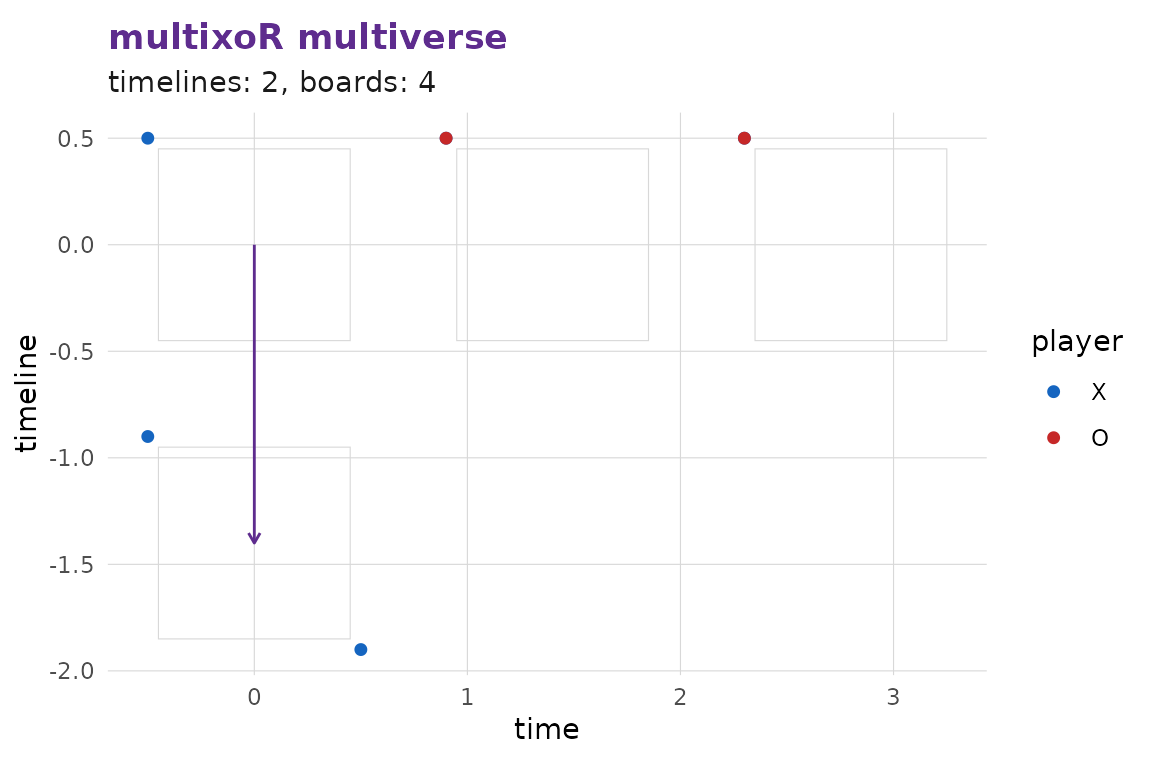
mxo_plot_multiverse() lays every board out on a timeline
× time grid and draws the branch connectors:
Three timeline-axis placements → win
A pure dL-axis win requires three placements at the
same (t, idx) on three adjacent timelines.
The example below branches three times from the empty initial board at
the same spatial cell.
w <- mxo_new_game()
w <- mxo_move(w, "present", 0L, 0L, 0L)
w <- mxo_move(w, "present", 0L, 1L, 1L)
w <- mxo_move(w, "branch",  0L, 0L, 63L)
w <- mxo_move(w, "present", 0L, 2L, 16L)
w <- mxo_move(w, "branch",  0L, 0L, 63L)
w <- mxo_move(w, "present", 0L, 3L, 17L)
w <- mxo_move(w, "branch",  0L, 0L, 63L)
mxo_status(w)$status
#> [1] "x_win"
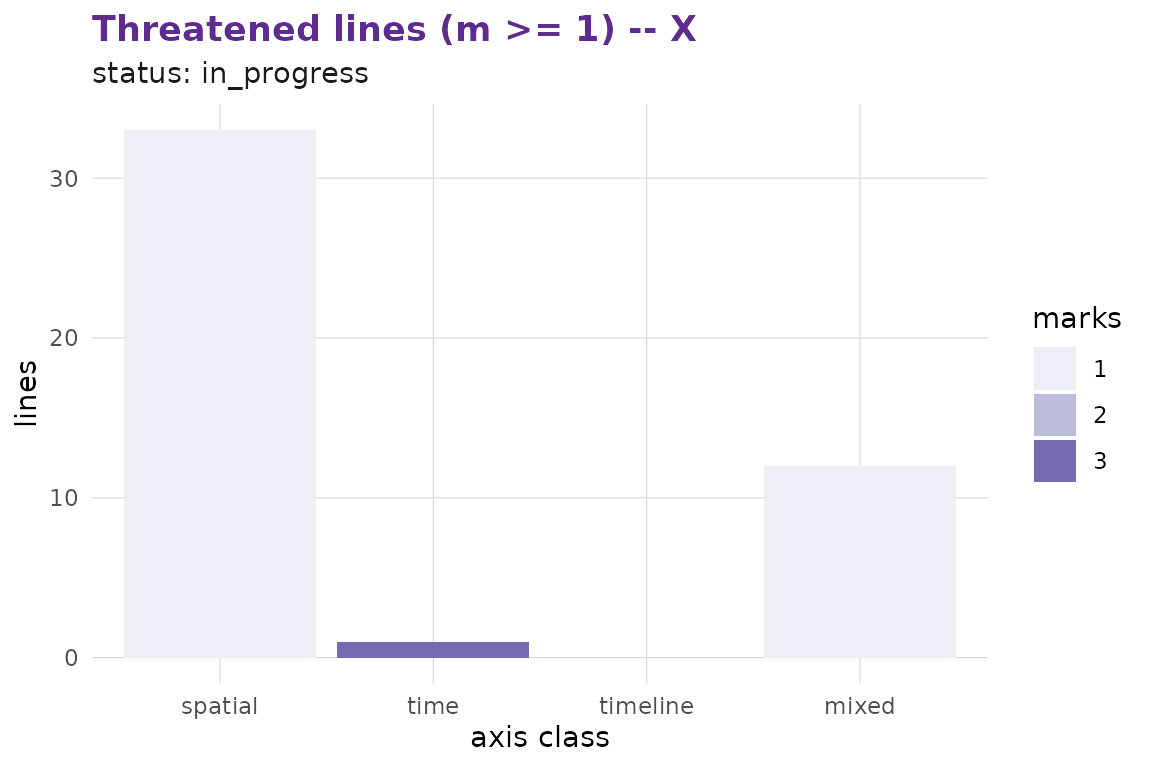
The same engine, geometry, and win-check produce all five axis-class
wins; mxo_plot_threats() shows the per-axis-class
threatened-line count that drives strategic play.
mxo_plot_threats(g, player = 1L, min_marks = 1L)