Self-play, simulation, and the §12 timeline-win finding
Source:vignettes/simulation.Rmd
simulation.Rmd


Policies
A policy is a parameterised picker function over Stack B’s searchers.
mxo_policy("random")
#>
#> ── multixoR policy ─────────────────────────────────────────────────────────────
#> ℹ Type: random
mxo_policy("heuristic", branch_policy = "none")
#>
#> ── multixoR policy ─────────────────────────────────────────────────────────────
#> ℹ Type: heuristic
#> ℹ Params:
#> →   branch_policy = none
Single self-play game
mxo_self_play() returns an mxo_game_record
that includes the per-ply heuristic score and the heuristic win
probability (X perspective). Those two columns are exactly what the
win-probability curve consumes.
rec <- mxo_self_play(
  mxo_policy("random"), mxo_policy("random"),
  config = mxo_config_default(n = 3L, k = 3L, ply_cap = 8L),
  seed = 1L
)
rec
#>
#> ── multixoR game record ────────────────────────────────────────────────────────
#> ℹ Outcome: draw (winner: NA)
#> ℹ Plies: 8; timelines: 3
#> ℹ Win axis: NA
head(as_tibble.mxo_game_record(rec), 6L)
#> # A tibble: 6 × 9
#>     ply player kind    L_src t_src   idx L_new  eval win_prob
#>   <int>  <int> <chr>   <int> <int> <int> <int> <dbl>    <dbl>
#> 1     1      1 present     0     0    24    NA    14    0.543
#> 2     2      2 present     0     1     3    NA    78    0.543
#> 3     3      1 branch      0     0    13     1   104    0.543
#> 4     4      2 present     0     2     0    NA    52    0.543
#> 5     5      1 present     1     0     9    NA    98    0.543
#> 6     6      2 present     1     1    20    NA   369    0.544
mxo_plot_win_prob(rec)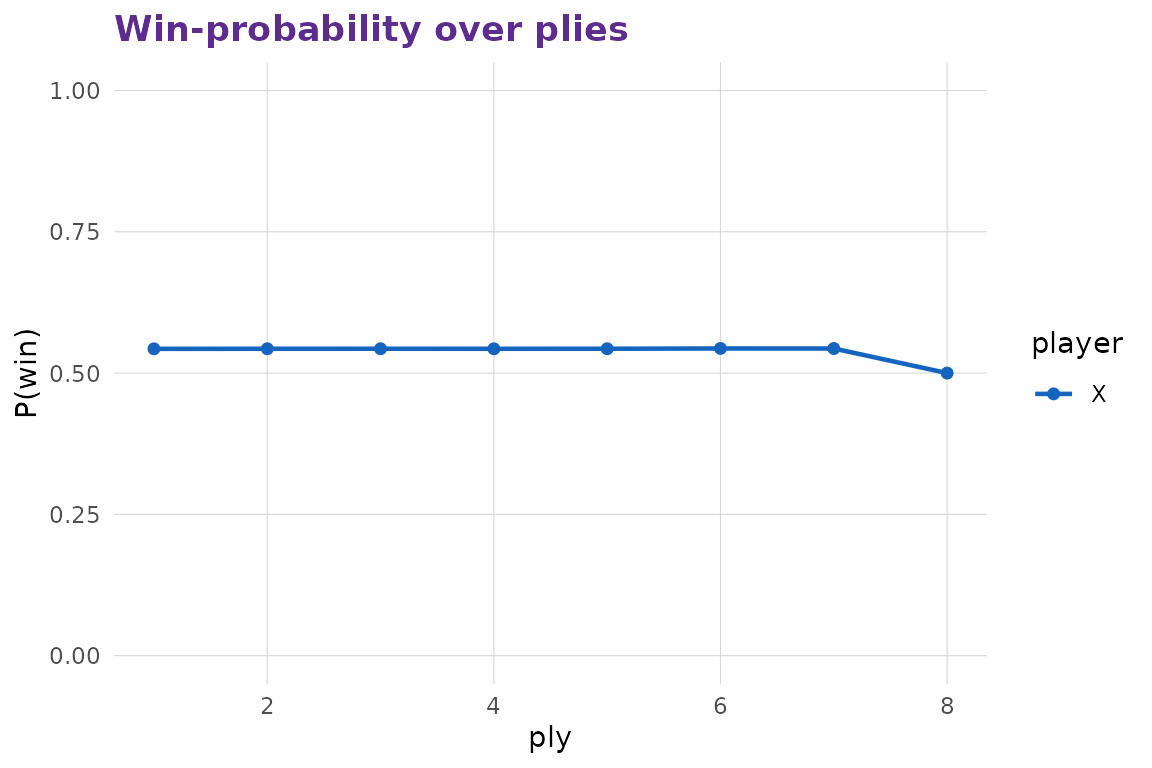
Batch simulation
mxo_simulate() runs many self-play games with
reproducible per-game sub-seeds. The summary surfaces the §12
stress-test number — the fraction of decisive games whose
winning line crosses timelines — the diagnostic the
orchestrator flagged as the rules’ main balance concern.
# Tiny `n_games` to keep the vignette build well under a minute on the
# pure-R engine; bump these up for real analyses.
sim <- mxo_simulate(
  mxo_policy("random", branch_policy = "all"),
  mxo_policy("random", branch_policy = "all"),
  n_games = 6L,
  config = mxo_config_default(n = 3L, k = 3L, ply_cap = 6L),
  seed = 7L, record_eval = FALSE, progress = FALSE
)
summary(sim)
#>
#> ── multixoR simulation summary ─────────────────────────────────────────────────
#> ℹ Games: 6
#> ℹ Win rates: X = 0; O = 0; draws = 1
#> ℹ Mean plies: 6; mean timelines: 4.33
#> ℹ Cross-timeline-win fraction: NA
mxo_timeline_win_rate() returns the same number with a
per-axis-class breakdown.
mxo_timeline_win_rate(
  mxo_policy("random"), mxo_policy("random"),
  n_games = 6L,
  config = mxo_config_default(n = 3L, k = 3L, ply_cap = 6L),
  seed = 7L
)
#> # A tibble: 1 × 8
#>   n_games n_wins cross_timeline_wins cross_timeline_fraction spatial  time
#>     <int>  <int>               <int>                   <dbl>   <int> <int>
#> 1       6      0                   0                      NA       0     0
#> # ℹ 2 more variables: timeline <int>, mixed <int>
Openings heatmap
mxo_opening_table() plays X’s first move from each
spatial cell against a fixed opponent. mxo_plot_opening()
renders the resulting win-rate heatmap as Z-slices.
tab <- mxo_opening_table(
  opponent = mxo_policy("random"),
  n_games_per_cell = 1L,
  config = mxo_config_default(n = 3L, k = 3L, ply_cap = 4L),
  seed = 1L
)
mxo_plot_opening(tab, n = 3L, d_spatial = 3L)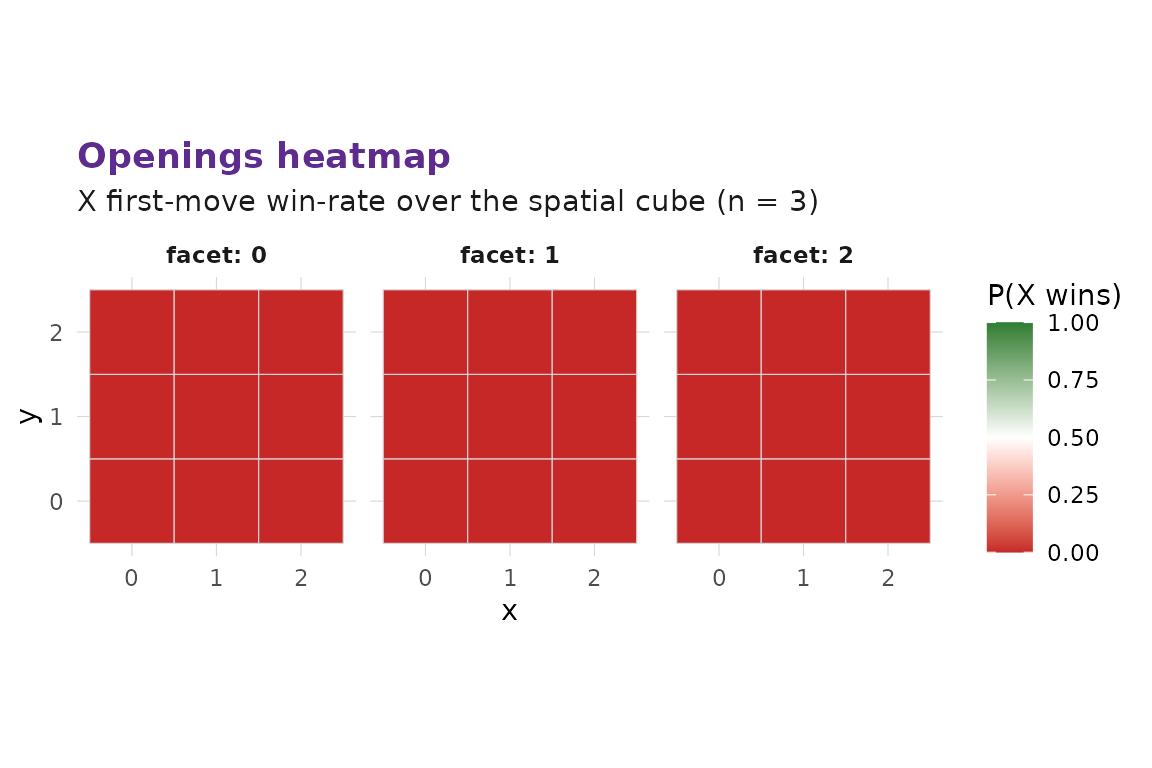
Calibration
mxo_make_calibration_data() +
mxo_fit_calibration() produce the mapping the engine’s
win-probability uses internally. The script that fits the package
default lives at data-raw/make_calibrator.R and ships the
result to R/sysdata.rda.