
synesthR turns literary text (German, English, French) into synchronized generative images and music. It extracts a sentence-level sentiment arc, lexical diversity, rhythm, and punctuation density into a single prosody score, then maps that score deterministically onto both a still image and a synchronized audio waveform — so the picture and the music are two views of the same analysis. Colour palettes and ggplot2 themes can be extracted from text, images, or audio through one interface, and an optional local-LLM layer can interpret the result.
How it works
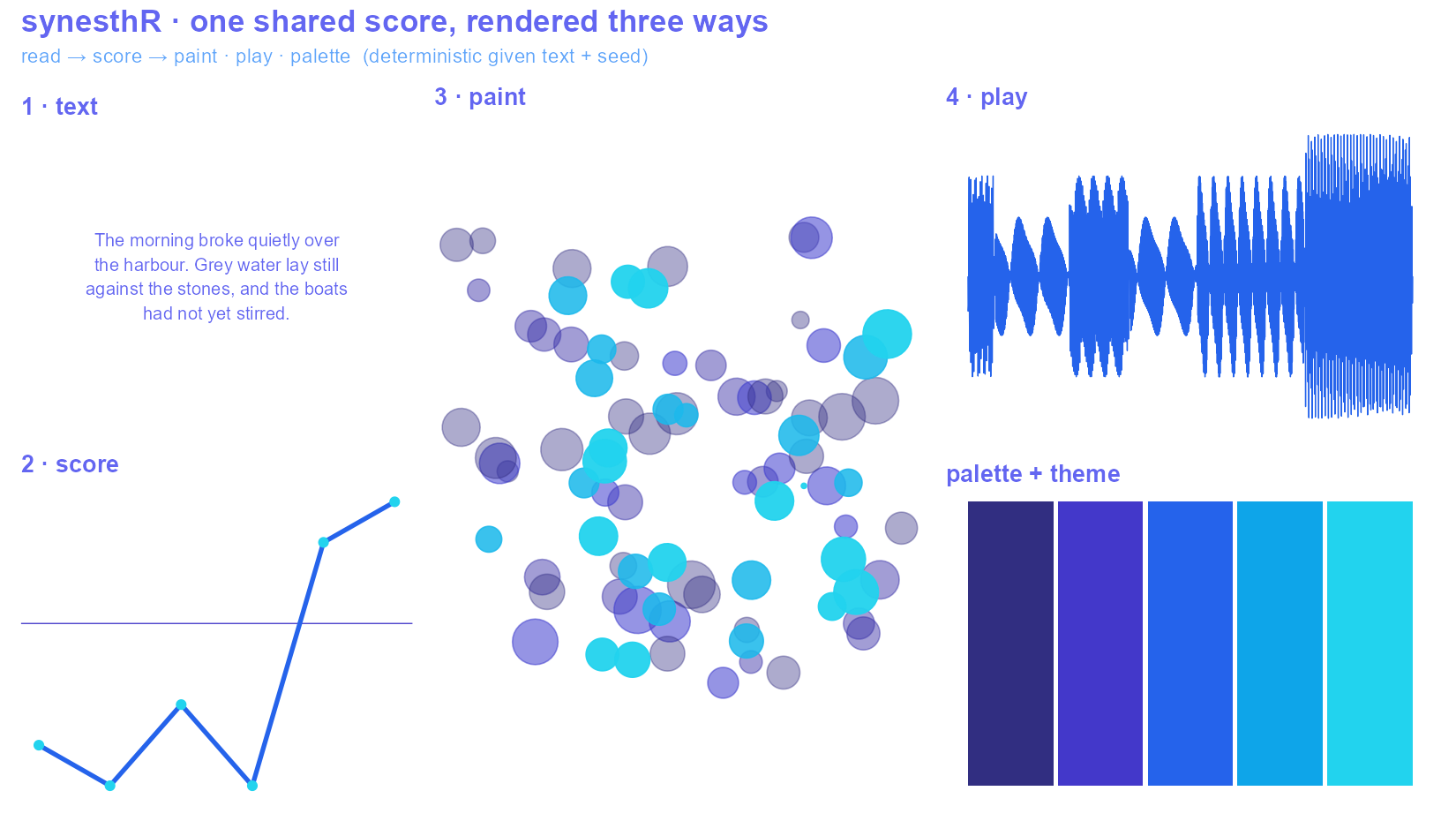
One shared score, rendered three ways — the same numbers become a picture, a piece of audio, and a colour palette:
Installation
# install.packages("pak")
pak::pak("r-heller/synesthR")
For a local checkout, install R 4.1 or later, then run:
install.packages("remotes")
remotes::install_deps(dependencies = TRUE)
remotes::install_local(".", dependencies = FALSE)
Missing text values are rejected; choose an explicit missing-data policy before reading a table. Seeds and sample rates must be finite integers.
Usage
library(synesthR)

text  <- syn_read_text(syn_example_text("en"), lang = "en")
score <- syn_score(text)
score
#> <prosody_score> — 6 sentences, lang "en"

# syn_paint() returns a ggplot, so it restyles like any other — here in the
# site's blue palette on a transparent canvas
blues <- c("#312E81", "#4338CA", "#2563EB", "#0EA5E9", "#22D3EE")
syn_paint(score) +
  ggplot2::scale_colour_gradientn(colours = blues) +
  ggplot2::theme(text             = ggplot2::element_text(colour = "#6366F1"),
                 plot.title       = ggplot2::element_text(colour = "#6366F1", face = "bold"),
                 plot.background  = ggplot2::element_rect(fill = NA, colour = NA),
                 panel.background = ggplot2::element_rect(fill = NA, colour = NA))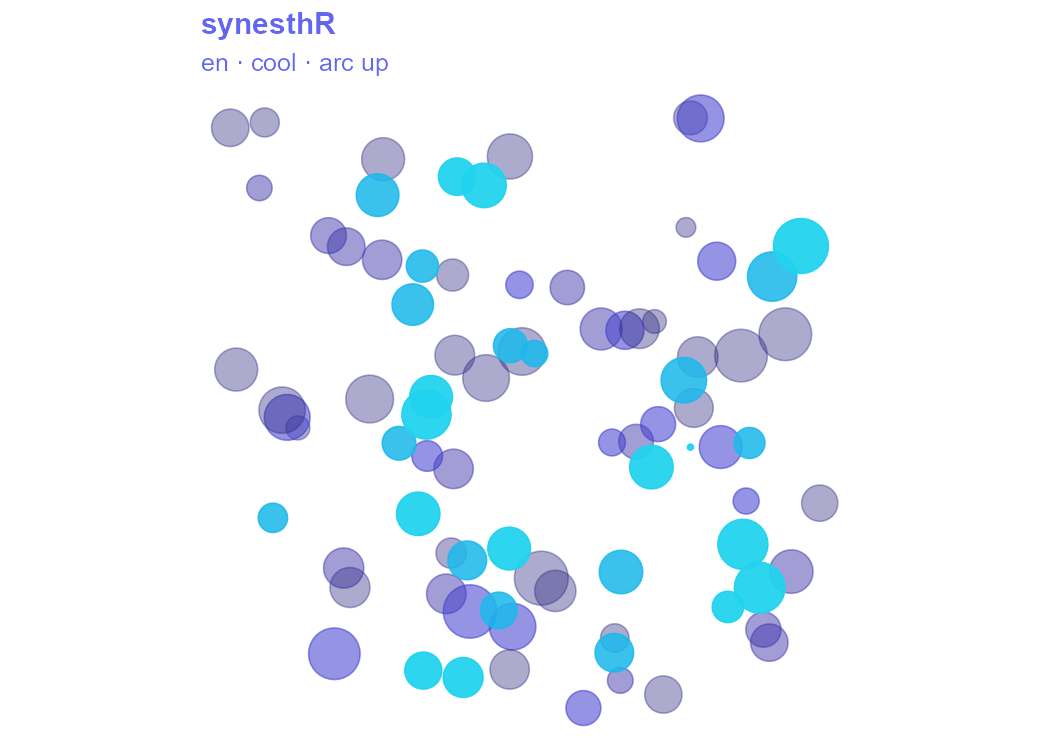
wav <- syn_write_wav(score, tempfile(fileext = ".wav"))

# a palette and matching ggplot2 theme, from the same score
syn_palette(score)
#> <syn_palette> - 5 colours, cool, from prosody_score
#> "#294D00" background
#> "#207900" shadow
#> "#00A65D" mid
#> "#00D5A4" accent
#> "#3BFFEB" highlight
The core (read -> score -> map -> paint/play/palette/media) is pure R, deterministic for the same text, language, seed, settings, and package versions. The core requires no external runtime. Its lexicon-based sentiment and rhythm features are artistic mappings, not validated psychological or linguistic measurements; irony, context, and out-of-vocabulary words can be misread. Optional extensions (image/audio palettes via magick/seewave, animation via gganimate, engraved scores via gm, a local LLM via ellmer, and Python interop via reticulate) live in Suggests and degrade gracefully when absent.