Tutorial page 3 of 4. Previous: « Playing in the app · Next: Playing from the R console »
Why four dimensions is hard
In the 3×3 game there are only 8 winning lines and you can see all of them at once. On the tesseract there are 520, and most of them are invisible in the Full view because they jump between little boards. The whole skill of the game is learning to see those hidden lines — and the tools below exist to help.
Slicing the hypercube
A line that changes k or l looks scattered
across the full board but becomes a plain straight line once you fix the
right axis. Consider a line that runs down the column of boards
— same (i, j), with l going
0 → 3:
b <- tsr_new_board()
moves <- list(
  c(1, 1, 0, 0), c(0, 0, 0, 0),   # X, O
  c(1, 1, 0, 1), c(0, 0, 0, 1),   # X, O
  c(1, 1, 0, 2), c(0, 0, 0, 2),   # X, O
  c(1, 1, 0, 3)                    # X completes l = 0..3 at i=1, j=1, k=0
)
for (m in moves) b <- tsr_move(b, m[1], m[2], m[3], m[4])
tsr_status(b)$winner   # 1 = X has won
#> [1] 1
In the Full view those four X’s land in four different little boards, so the win is easy to miss:
tsr_plot(b)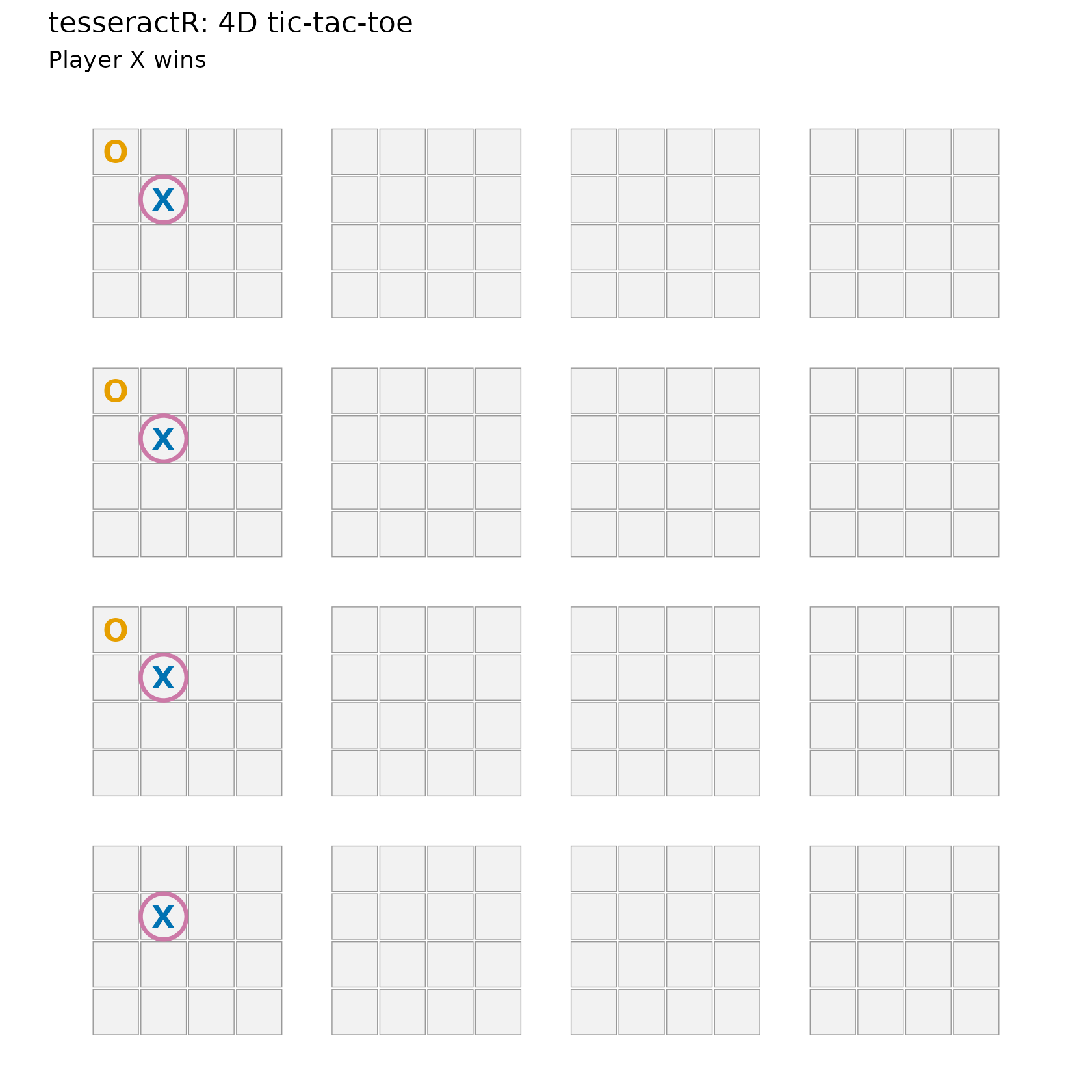
Fix the k axis at 0 and the same four cells
line up vertically inside one slice — now it reads as the straight line
it really is:
tsr_plot_slice(b, axis = "k", at = 0)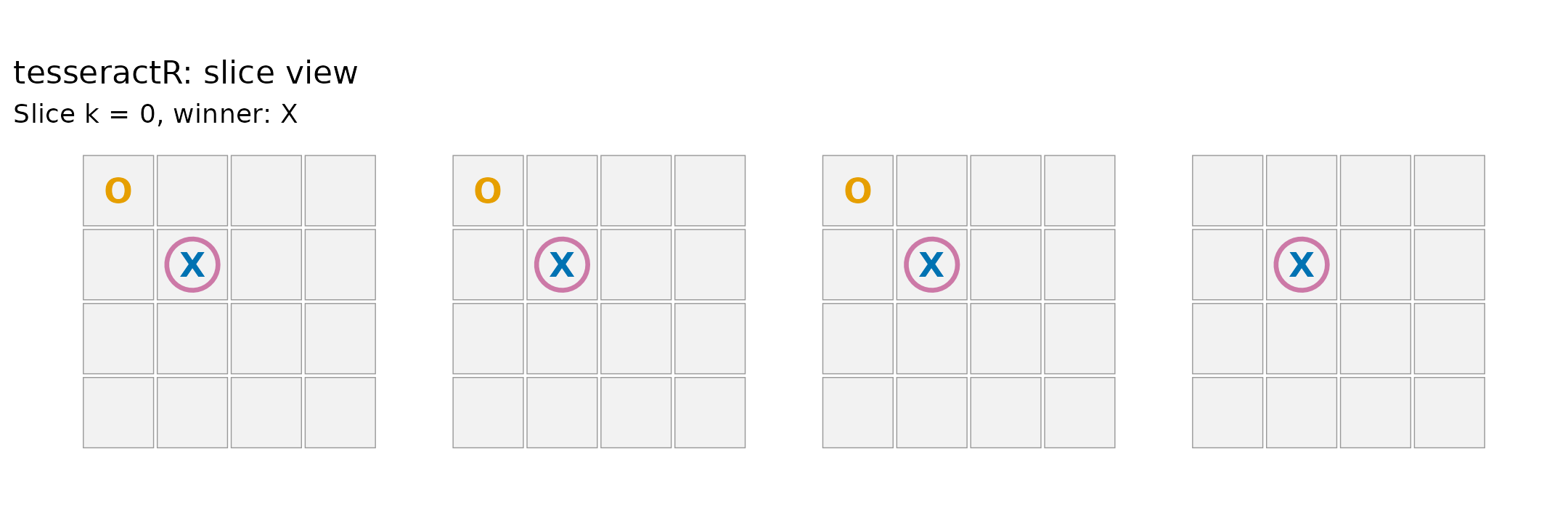
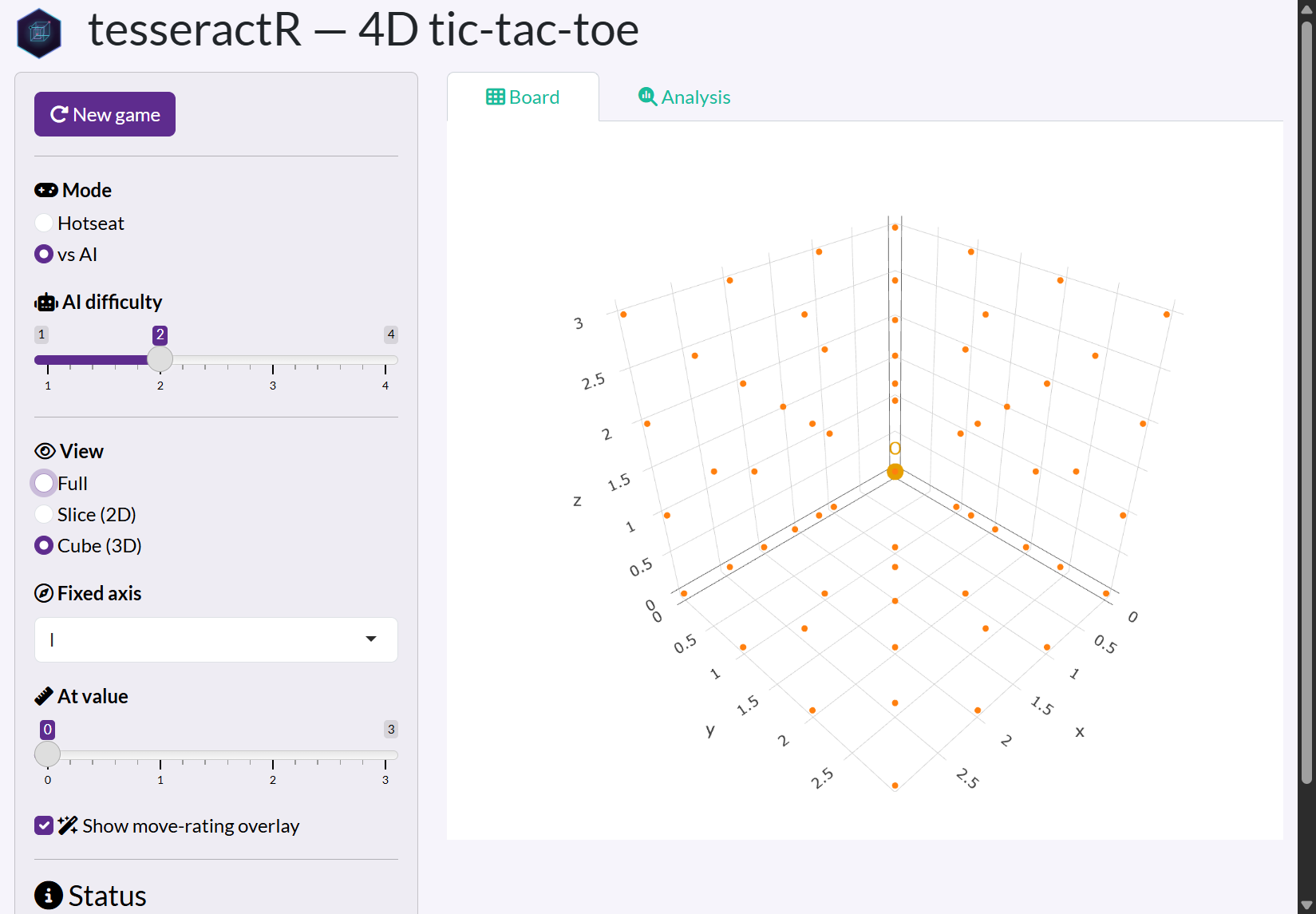
The app exposes exactly this with the Slice (2D) and rotatable Cube (3D) views — try every fixed axis when you are hunting for a threat:
Let the engine point at the good moves
You do not have to find every threat by eye.
tsr_rate_moves() scores every legal move for the player to
move and flags the important ones. Suppose X already has three in a line
and it is X’s turn:
b <- tsr_new_board()
moves <- list(
  c(0, 0, 0, 0), c(3, 3, 3, 3),   # X, O
  c(1, 0, 0, 0), c(3, 3, 3, 2),   # X, O
  c(2, 0, 0, 0), c(3, 3, 3, 1)    # X, O  -> X has i = 0,1,2 at j=k=l=0
)
for (m in moves) b <- tsr_move(b, m[1], m[2], m[3], m[4])

rated <- tsr_rate_moves(b, method = "heuristic")
# the winning completion is flagged:
rated[rated$is_winning, c("cell", "i", "j", "k", "l", "win_prob", "is_winning")]
#> # A tibble: 1 × 7
#>    cell     i     j     k     l win_prob is_winning
#>   <int> <int> <int> <int> <int>    <dbl> <lgl>
#> 1     4     3     0     0     0        1 TRUE
tsr_rate_moves() returns one row per legal move with its
win_prob, a rank, and the logical flags
is_best, is_winning, and
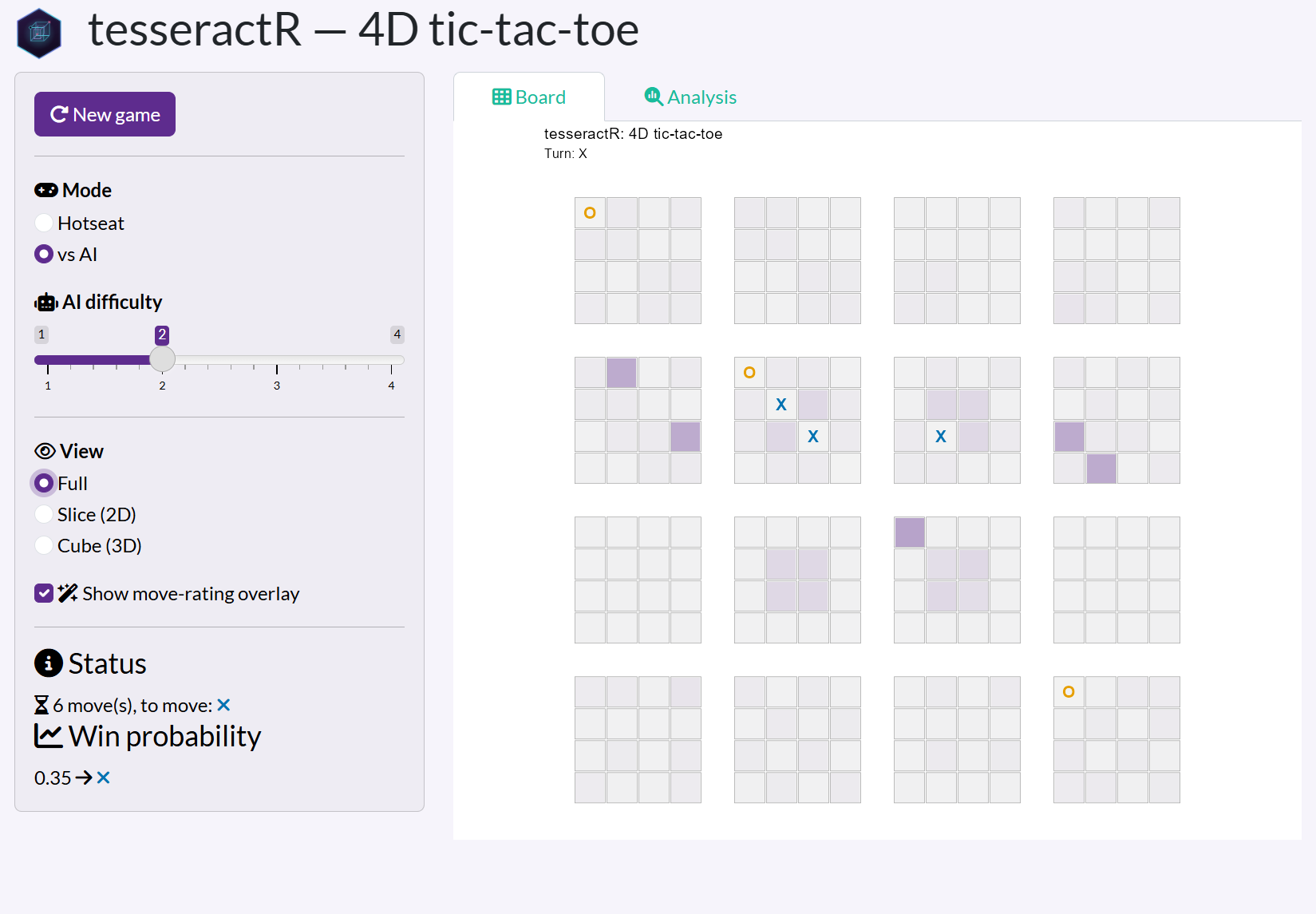
is_blocking. The same data drives the move-rating
overlay in the app — darker cells are higher
win_prob:
Blocking
The same flags catch defence. When your opponent is one move
from a line, the move that denies it is flagged
is_blocking. A simple habit wins a lot of games:
each turn, if any move is is_winning, take it;
otherwise if any move is is_blocking, play it.
top <- rated[order(-rated$win_prob), c("cell", "win_prob", "is_best", "is_winning", "is_blocking")]
head(top, 3)
#> # A tibble: 3 × 5
#>    cell win_prob is_best is_winning is_blocking
#>   <int>    <dbl> <lgl>   <lgl>      <lgl>
#> 1     4    1     TRUE    TRUE       FALSE
#> 2    64    0.745 FALSE   FALSE      TRUE
#> 3    22    0.552 FALSE   FALSE      FALSE
A few rules of thumb
-
Central cells touch more lines. Coordinates near
the middle (
1and2) sit on far more of the 520 lines than the corners — they are worth more. - Count threats, not marks. A cell that advances two different lines at once is a fork: even a perfect defender can only block one.
-
Slice before you commit. If a position feels murky,
cycle the fixed axis through
i, j, k, l— a threat that is invisible in one slice is usually obvious in another. - Watch the win-probability swing. A move that drops your number sharply was probably a mistake; the Analysis tab shows exactly where those swings happened.