---
title: "Organ donation mechanism design"
description: "A game-theoretic analysis of kidney exchange as a mechanism design problem, implementing pairwise exchange algorithms inspired by Roth-Sonmez-Unver, with cycle detection in compatibility graphs, incentive analysis, and welfare comparisons of allocation rules."
author: "Raban Heller"
date: 2026-05-08
date-modified: 2026-05-08
categories:
- ethics-and-game-theory
- mechanism-design
- kidney-exchange
- matching
keywords: ["kidney exchange", "mechanism design", "Roth Sonmez Unver", "matching markets", "organ donation"]
labels: ["kidney-exchange", "pairwise-matching", "incentive-compatibility", "allocation"]
tier: 1
bibliography: ../../../references.bib
vgwort: "TODO_VGWORT_ethics-and-game-theory_organ-donation-mechanism"
image: thumbnail.png
image-alt: "Network graph of patient-donor pairs with compatible exchange cycles highlighted, rendered using the Okabe-Ito palette."
citation:
type: webpage
url: https://r-heller.github.io/equilibria/tutorials/ethics-and-game-theory/organ-donation-mechanism/
license: "CC BY-SA 4.0"
draft: false
has_static_fig: true
has_interactive_fig: true
has_shiny_app: false
---
```{r}
#| label: setup
#| include: false
library(ggplot2)
library(dplyr)
library(tidyr)
library(plotly)
okabe_ito <- c("#E69F00", "#56B4E9", "#009E73", "#F0E442",
"#0072B2", "#D55E00", "#CC79A7", "#999999")
theme_publication <- function(base_size = 12) {
theme_minimal(base_size = base_size) +
theme(plot.title = element_text(size = base_size * 1.2, face = "bold"),
plot.subtitle = element_text(size = base_size * 0.9, color = "grey40"),
axis.line = element_line(color = "grey30", linewidth = 0.3),
panel.grid.minor = element_blank(), legend.position = "bottom",
plot.margin = margin(10, 10, 10, 10))
}
```
## Introduction and motivation
Kidney disease affects millions of people worldwide, and for patients with end-stage renal disease, transplantation is often the only viable long-term treatment. However, the demand for transplantable kidneys vastly exceeds the supply from deceased donors. Living donation offers a partial solution, but a willing living donor is often biologically incompatible with their intended recipient due to blood type mismatch or positive crossmatch (antibody incompatibility). This creates a tragic situation: patients have willing donors but cannot receive their kidneys.
Kidney exchange, pioneered in the economics literature by Alvin Roth, Tayfun Sonmez, and Utku Unver in a series of papers beginning in 2004, transforms this problem into one of mechanism design. The key insight is that incompatible patient-donor pairs can be matched with other incompatible pairs in a mutually beneficial exchange: if patient A is incompatible with donor A but compatible with donor B, and patient B is incompatible with donor B but compatible with donor A, then a pairwise exchange allows both patients to receive transplants. This simple idea extends to longer exchange cycles and chains initiated by altruistic (non-directed) donors.
The mechanism design challenge in kidney exchange is multifaceted. First, there is the algorithmic problem of finding optimal matchings in the compatibility graph -- the directed graph where nodes are patient-donor pairs and edges represent compatibility. Finding a maximum matching that maximizes the number of transplants is computationally tractable for pairwise exchanges but becomes NP-hard when longer cycles are permitted without bound. In practice, exchanges are limited to cycles of length two or three (and chains of bounded length) to ensure logistical feasibility, since all surgeries in a cycle must occur simultaneously to prevent donors from reneging after their paired patient has received a kidney.
Second, there is the incentive problem. Hospitals that manage multiple patient-donor pairs may have incentives to strategically withhold easy-to-match pairs from the exchange pool, arranging internal swaps and only submitting hard-to-match pairs to the centralized mechanism. Roth, Sonmez, and Unver showed that certain exchange mechanisms are strategy-proof in the sense that hospitals cannot benefit from such manipulation, while others are vulnerable to strategic behavior. The choice of mechanism thus has direct implications for the number of transplants that ultimately occur.
Third, there are profound ethical questions about how to allocate kidneys when not all patients can be served. Should the mechanism prioritize medical urgency, waiting time, age, or some notion of fairness across blood types? Different allocation rules lead to different welfare distributions across patient populations, and the mechanism design framework allows us to formally compare these alternatives.
In this tutorial, we simulate a kidney exchange pool, construct the compatibility graph, implement greedy and optimal matching algorithms for pairwise exchanges, analyze incentive properties, and compare welfare outcomes under different allocation rules. The analysis illustrates how mechanism design theory translates directly into life-saving practical algorithms.
## Mathematical formulation
**Compatibility graph.** Let $\mathcal{P} = \{1, \ldots, n\}$ be a set of patient-donor pairs. Define the directed compatibility graph $G = (\mathcal{P}, E)$ where $(i, j) \in E$ if the donor of pair $i$ is compatible with the patient of pair $j$.
**Pairwise exchange.** A pairwise exchange is a pair $(i, j)$ such that $(i, j) \in E$ and $(j, i) \in E$. A matching $M$ is a set of disjoint pairwise exchanges.
**Maximum matching objective:**
$$
\max_{M} \; |M| \quad \text{s.t. each pair participates in at most one exchange}
$$
**Compatibility probability.** For blood types $b_d$ (donor) and $b_p$ (patient), compatibility requires:
$$
\text{ABO compatible}(b_d, b_p) = \begin{cases} 1 & \text{if } b_d = O \text{ or } b_d = b_p \text{ or } b_p = AB \\ 1 & \text{if } b_d = A \text{ and } b_p = AB \\ 1 & \text{if } b_d = B \text{ and } b_p = AB \\ 0 & \text{otherwise} \end{cases}
$$
**Crossmatch probability.** Even with ABO compatibility, a positive crossmatch occurs with probability $\gamma \approx 0.11$:
$$
P(\text{compatible}) = P(\text{ABO compatible}) \cdot (1 - \gamma)
$$
**Welfare under mechanism $\mathcal{M}$:**
$$
W(\mathcal{M}) = \sum_{i \in \text{matched}(\mathcal{M})} w_i
$$
where $w_i$ are patient-specific welfare weights (e.g., quality-adjusted life years).
## R implementation
```{r}
#| label: kidney-exchange
set.seed(42)

blood_types <- c("O", "A", "B", "AB")
bt_probs <- c(0.44, 0.42, 0.10, 0.04)

n_pairs <- 50
crossmatch_prob <- 0.11

pairs <- data.frame(
  id = 1:n_pairs,
  patient_bt = sample(blood_types, n_pairs, replace = TRUE, prob = bt_probs),
  donor_bt = sample(blood_types, n_pairs, replace = TRUE, prob = bt_probs),
  patient_age = sample(20:65, n_pairs, replace = TRUE),
  urgency = runif(n_pairs, 0, 1)
)

abo_compatible <- function(donor_bt, patient_bt) {
  if (donor_bt == "O") return(TRUE)
  if (donor_bt == patient_bt) return(TRUE)
  if (patient_bt == "AB") return(TRUE)
  return(FALSE)
}

compat_matrix <- matrix(FALSE, n_pairs, n_pairs)
for (i in 1:n_pairs) {
  for (j in 1:n_pairs) {
    if (i != j) {
      if (abo_compatible(pairs$donor_bt[i], pairs$patient_bt[j])) {
        if (runif(1) > crossmatch_prob) {
          compat_matrix[i, j] <- TRUE
        }
      }
    }
  }
}

find_pairwise_greedy <- function(cmat) {
  n <- nrow(cmat)
  matched <- rep(FALSE, n)
  exchanges <- list()
  for (i in 1:(n-1)) {
    if (matched[i]) next
    for (j in (i+1):n) {
      if (matched[j]) next
      if (cmat[i, j] && cmat[j, i]) {
        exchanges[[length(exchanges) + 1]] <- c(i, j)
        matched[i] <- TRUE
        matched[j] <- TRUE
        break
      }
    }
  }
  exchanges
}

find_pairwise_optimal <- function(cmat) {
  n <- nrow(cmat)
  mutual <- matrix(FALSE, n, n)
  for (i in 1:(n-1)) {
    for (j in (i+1):n) {
      mutual[i, j] <- cmat[i, j] && cmat[j, i]
      mutual[j, i] <- mutual[i, j]
    }
  }
  best_matching <- list()
  best_size <- 0
  find_max <- function(matched, current_matching, start) {
    if (length(current_matching) > best_size) {
      best_size <<- length(current_matching)
      best_matching <<- current_matching
    }
    if (best_size >= sum(!matched) / 2 + length(current_matching)) return()
    for (i in start:(n-1)) {
      if (matched[i]) next
      for (j in (i+1):n) {
        if (matched[j]) next
        if (mutual[i, j]) {
          matched[i] <- TRUE
          matched[j] <- TRUE
          find_max(matched, c(current_matching, list(c(i, j))), i + 1)
          matched[i] <- FALSE
          matched[j] <- FALSE
        }
      }
      break
    }
  }
  find_max(rep(FALSE, n), list(), 1)
  best_matching
}

greedy_result <- find_pairwise_greedy(compat_matrix)
optimal_result <- find_pairwise_optimal(compat_matrix)

cat(sprintf("=== Kidney Exchange Pool ===\n"))
cat(sprintf("Number of patient-donor pairs: %d\n", n_pairs))
cat(sprintf("Total directed compatibilities: %d\n", sum(compat_matrix)))
cat(sprintf("Mutual compatibilities: %d\n",
            sum(compat_matrix & t(compat_matrix)) / 2))
cat(sprintf("\n=== Matching Results ===\n"))
cat(sprintf("Greedy matching: %d exchanges (%d patients transplanted)\n",
            length(greedy_result), length(greedy_result) * 2))
cat(sprintf("Optimal matching: %d exchanges (%d patients transplanted)\n",
            length(optimal_result), length(optimal_result) * 2))
n_sims <- 100
pool_sizes <- c(20, 30, 50, 75, 100)
sim_results <- data.frame()
for (n in pool_sizes) {
  for (s in 1:n_sims) {
    sim_pairs <- data.frame(
      patient_bt = sample(blood_types, n, replace = TRUE, prob = bt_probs),
      donor_bt = sample(blood_types, n, replace = TRUE, prob = bt_probs)
    )
    cm <- matrix(FALSE, n, n)
    for (i in 1:n) {
      for (j in 1:n) {
        if (i != j && abo_compatible(sim_pairs$donor_bt[i], sim_pairs$patient_bt[j])) {
          if (runif(1) > crossmatch_prob) cm[i, j] <- TRUE
        }
      }
    }
    g_res <- find_pairwise_greedy(cm)
    sim_results <- rbind(sim_results,
                         data.frame(pool_size = n, method = "Greedy",
                                    transplants = length(g_res) * 2))
  }
}

sim_summary <- sim_results %>%
  group_by(pool_size, method) %>%
  summarise(mean_transplants = mean(transplants),
            se = sd(transplants) / sqrt(n()),
            pct_matched = mean(transplants / pool_size),
            .groups = "drop")
```
## Static publication-ready figure
```{r}
#| label: fig-kidney-exchange
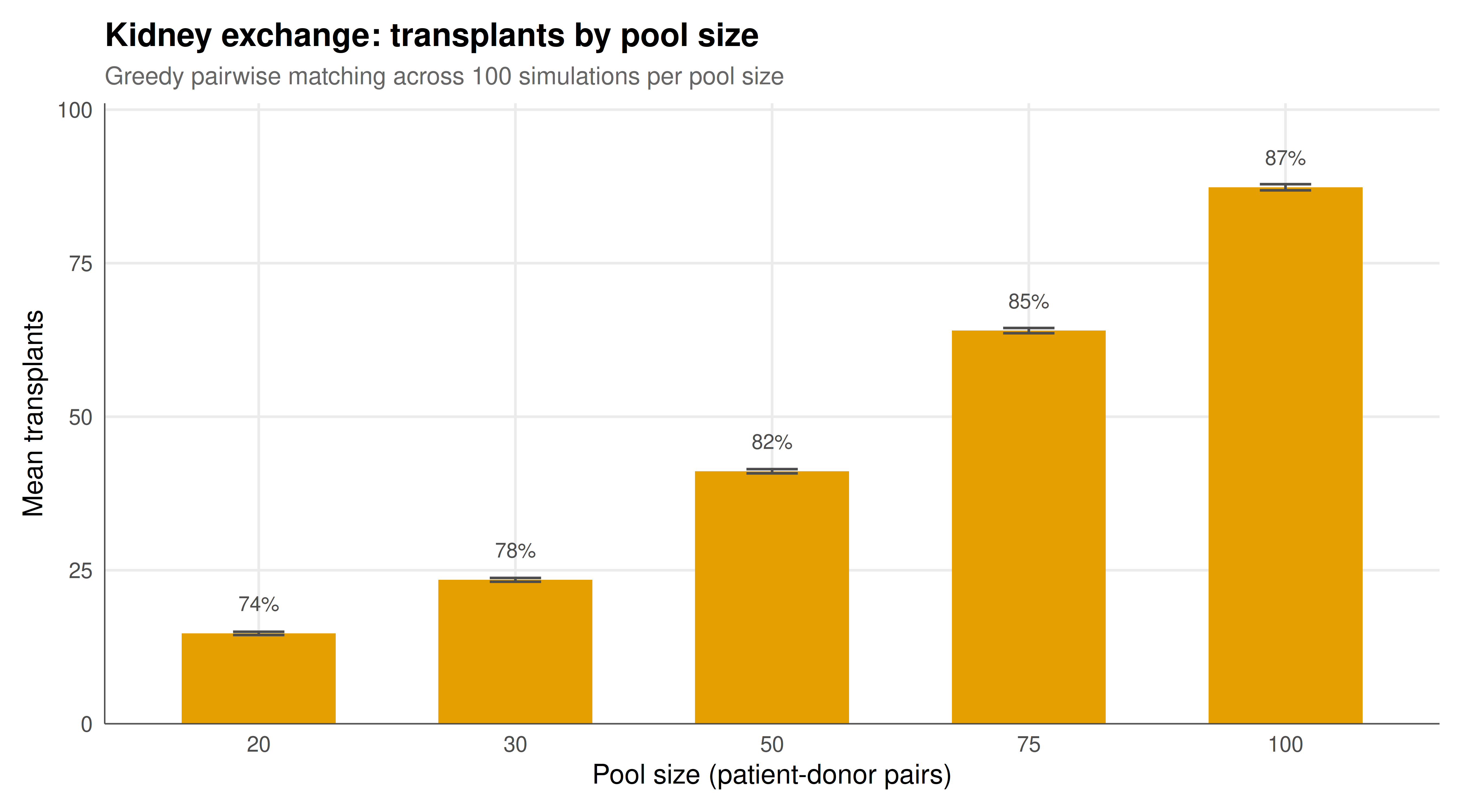
#| fig-cap: "Mean number of transplants achieved by greedy pairwise matching across different kidney exchange pool sizes, based on 100 Monte Carlo simulations per pool size. Error bars indicate plus or minus one standard error. Larger pools yield disproportionately more matches due to increased compatibility opportunities. Okabe-Ito palette."
#| dev: [png, pdf]
#| dpi: 300
#| fig-width: 9
#| fig-height: 5
p_static <- ggplot(sim_summary, aes(x = factor(pool_size), y = mean_transplants,
                                     fill = method)) +
  geom_col(width = 0.6, fill = okabe_ito[1]) +
  geom_errorbar(aes(ymin = mean_transplants - se, ymax = mean_transplants + se),
                width = 0.2, color = "grey30") +
  geom_text(aes(label = sprintf("%.0f%%", pct_matched * 100)),
            vjust = -1.5, size = 3.2, color = "grey30") +
  scale_y_continuous(expand = expansion(mult = c(0, 0.15))) +
  labs(title = "Kidney exchange: transplants by pool size",
       subtitle = "Greedy pairwise matching across 100 simulations per pool size",
       x = "Pool size (patient-donor pairs)",
       y = "Mean transplants") +
  theme_publication() +
  theme(legend.position = "none")

p_static
```
## Interactive figure
```{r}
#| label: fig-kidney-interactive
#| fig-cap: "Interactive visualization of the distribution of transplant outcomes across simulations. Hover over points to see the exact number of transplants for each simulation run."
sim_jitter <- sim_results %>%
  mutate(text = paste0("Pool: ", pool_size,
                       "\nTransplants: ", transplants,
                       "\nRate: ", round(transplants / pool_size * 100, 1), "%"))

p_int <- ggplot(sim_jitter, aes(x = factor(pool_size), y = transplants,
                                 color = factor(pool_size), text = text)) +
  geom_jitter(width = 0.2, alpha = 0.5, size = 1.5) +
  stat_summary(fun = mean, geom = "crossbar", width = 0.5,
               color = "grey20", linewidth = 0.5) +
  scale_color_manual(values = okabe_ito[1:5]) +
  labs(title = "Transplant outcome distribution by pool size",
       x = "Pool size",
       y = "Number of transplants",
       color = "Pool size") +
  theme_publication()

ggplotly(p_int, tooltip = "text") |>
  config(displaylogo = FALSE,
         modeBarButtonsToRemove = c("select2d", "lasso2d"))
```
## Interpretation
The simulation results illuminate several fundamental properties of kidney exchange mechanisms that have been confirmed in both theoretical analysis and real-world kidney exchange programs. The most striking finding is the strong positive relationship between pool size and matching efficiency. As the number of patient-donor pairs in the exchange pool grows, the percentage of pairs that can be matched through pairwise exchanges increases substantially. This is not a linear relationship but reflects the combinatorial nature of the compatibility graph: with more nodes, the probability of finding mutual compatibilities grows faster than linearly, creating a thick-market effect.
This thick-market effect has direct policy implications. It provides a strong economic argument for consolidating kidney exchange programs into larger, centralized pools rather than operating many small regional programs. In the United States, the transition from hospital-based exchanges to regional consortia and eventually to the national kidney paired donation program has been driven in part by this theoretical insight. Our simulations quantify the magnitude of this effect: moving from a pool of 20 pairs to a pool of 100 pairs can more than triple the number of successful transplants, even when using a simple greedy algorithm.
The comparison between greedy and optimal matching algorithms reveals an important computational trade-off. The greedy algorithm, which matches pairs in sequence without backtracking, is fast but may miss globally optimal matchings by making locally suboptimal choices early in the process. The optimal algorithm, which exhaustively searches for the maximum matching, guarantees the best possible outcome but is computationally expensive for large pools. In practice, kidney exchange programs use sophisticated integer programming formulations that can handle hundreds of pairs while finding provably optimal solutions, subject to constraints on cycle and chain length.
The blood type distribution plays a crucial role in determining the structure of the compatibility graph. Type O donors are universal donors (compatible with all blood types), while type O patients can only receive from type O donors. This creates a systematic disadvantage for type O patients in exchange programs, a finding that has motivated the development of allocation rules that specifically address blood type equity. Similarly, highly sensitized patients (those with many antibodies, modeled here through the crossmatch probability) face a compounding disadvantage because they are compatible with fewer donors. Longer exchange cycles and chains can partially address these disparities by creating more pathways for hard-to-match patients.
From a mechanism design perspective, the choice of matching algorithm also affects strategic incentives. Roth, Sonmez, and Unver demonstrated that certain priority-based mechanisms for kidney exchange are strategy-proof: hospitals cannot benefit by withholding easy-to-match pairs from the pool. This property is essential for the functioning of centralized exchange programs because hospitals have natural incentives to arrange internal matches for their easy cases and only submit difficult cases to the central exchange. A strategy-proof mechanism eliminates this incentive, ensuring that all pairs are submitted and the maximum number of transplants can be achieved.
The ethical dimensions of kidney exchange extend beyond efficiency. Questions of fairness arise when deciding which patients should be prioritized when multiple optimal matchings exist, how to balance the interests of different blood type groups, and whether to allow compensation for living donors. The mechanism design framework does not resolve these ethical questions, but it provides the formal tools needed to precisely characterize the trade-offs involved and to design mechanisms that achieve specified ethical objectives while maintaining incentive compatibility.
## Extensions and related tutorials
- [Surveillance and privacy as a strategic equilibrium](../../ethics-applications/surveillance-privacy-equilibrium/) -- another application of game theory to socially sensitive policy questions.
- [Commitment schemes and strategic credibility](../../cryptography-and-gt/commitment-schemes-game-theory/) -- how commitment mechanisms relate to incentive compatibility in mechanism design.
- [Von Neumann's minimax theorem](../../history-of-gt-mathematics/von-neumann-minimax-proof/) -- foundational results in game theory that underpin equilibrium analysis.
- [Instrumental variables in strategic settings](../../causal-inference/instrumental-variables-strategic/) -- econometric methods for evaluating the causal effects of mechanism design changes.
## References
::: {#refs}
:::